

Edtech Has Always Failed. This Time, It’s Different.
The only way tech will transform school.


Edtech has always been a graveyard of broken promises. Every shiny new tool that promises to “revolutionize” education is notorious for one thing and one thing only: failing.
No technology has ever “revolutionized” education like it’s promised to.
But this time, it’s different.
How edtech started (and how it’s going)
In the 1800s there was a gold rush, and today, there’s a technology rush.
Schools are stumbling over themselves trying to be more “tech-forward,” shelling out astronomical amounts of money just to implement new technologies in their classrooms.
Now, everything is digitized.
And I mean: everything.
Homework happens through a digital dashboard. Worksheets are only accessible through apps. Students carry Chromebooks instead of physical textbooks. The entire school day got “an innovation upgrade,” meaning kids are required to be on screens, whether they want to or not. The Wall Street Journal found that students in grades one through twelve average 98 minutes a day on school-issued devices, over 20% of their instructional time.
But is it working?
We’ve seen the lowest 12th-grade reading and math scores in NAEP history. 45% of high school seniors now score below basic in math. Kids have never had more access to technology than they do right now, and they are learning less than they ever have before.
That’s because these edtech tools aren’t built around learning science.
Learning scientists have known for over 40 years that the time-based, lecture-based classroom (i.e. the standard classroom we all grew up in) is the worst way for kids to learn. So when you drop technology into that environment, it doesn’t matter how amazing that technology may be. It can only operate within the constraints of that model.
This is why edtech tools have historically amounted to little more than a replacement for pen and paper. These tools can’t revolutionize anything. They’re tech for tech’s sake.
Which means, the model itself is the failure. Not the tech.
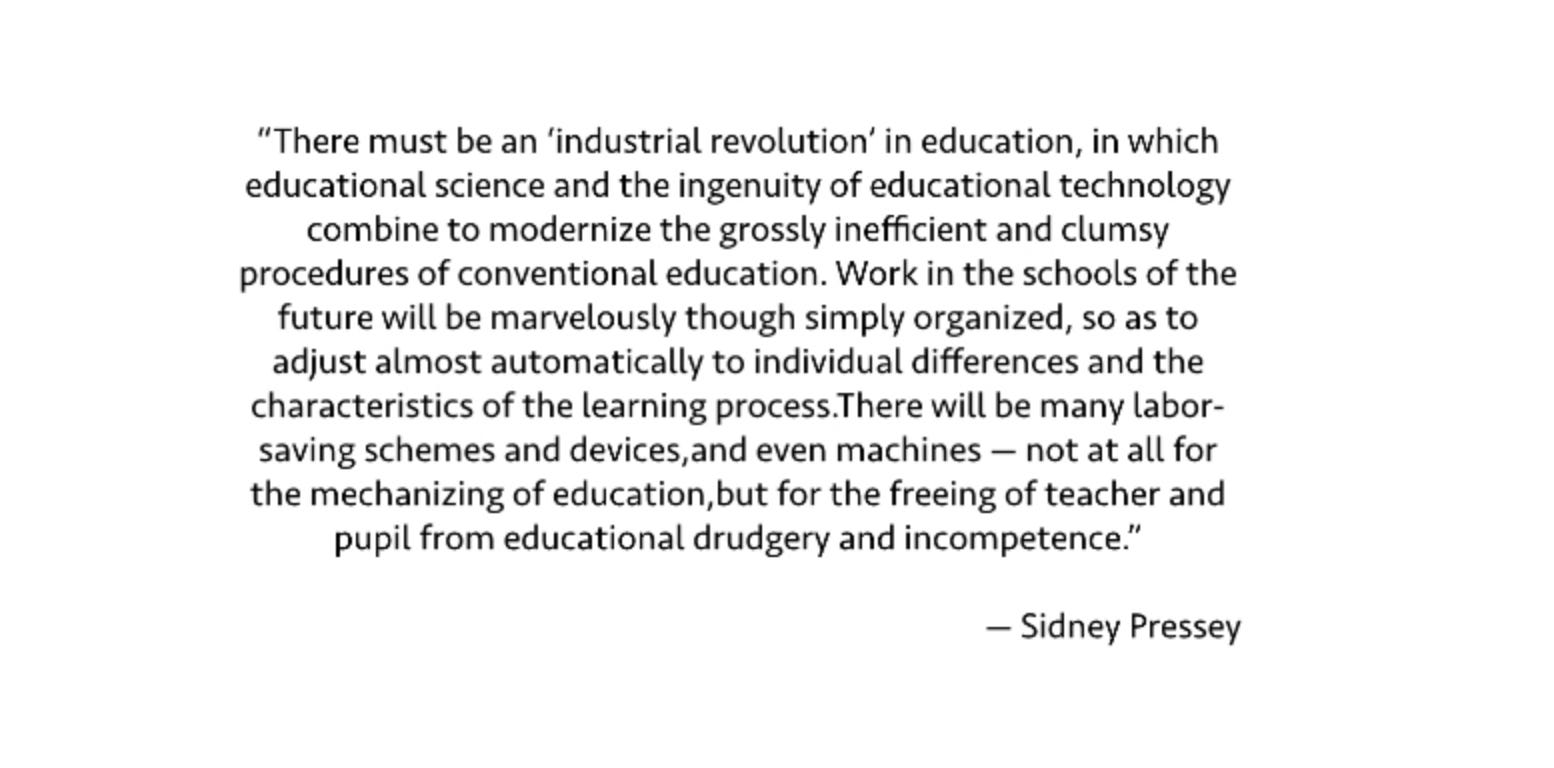
Nearly a century ago, the inventor of the first teaching machine saw it coming. Sidney Pressey argued that for technology to work in the classroom, it needed to “modernize the grossly inefficient and clumsy procedures of conventional education.” Unfortunately, we spent a hundred years digitizing those procedures rather than reimagining them.
If we want to truly revolutionize education, we need to transcend the time-based, lecture-based classroom entirely and get to the heart of what makes a prime learning environment.
90% of learning is sheer motivation
The perfect equation for an “ideal” learner is 10% curriculum and 90% motivation.
Let me explain.
10% of learning is the academics being delivered at the right pace and level. This is what learning scientists call the zone of proximal development: the sweet spot where material is just hard enough to challenge a kid but not so hard it frustrates them. It’s different for every student, which is exactly why a standardized classroom can’t deliver it, and why edtech dropped into that classroom does virtually nothing.
90% of learning is having a motivated student. Are they excited? Curious? Determined? Do they care about the outcome? How high are the stakes? What’s the reward? You could hand the smartest kid in the world the best software ever written, but if that kid isn’t motivated to learn, it’s game over. A motivated C student will almost always outperform an unmotivated A student.
Once schools nail this 90/10 equation, that’s when edtech can truly start to make an impact.
Motivation unlocks the power of edtech
I want to share what this looks like in practice with the school I co-founded called Alpha School.
Students at Alpha don’t learn from a teacher standing at the front of the classroom. Instead, they master academics with AI tutors, also known as “adaptive apps.” The name is fitting: the tech adapts to every student’s unique knowledge level to keep them in the zone of proximal development at all times. The result is that our students learn twice as much in two hours a day, and Alpha’s classes consistently rank in the top 1% in the nation.
Edtech is exceptional at the 10%: delivering the right material at the right pace for every single student.
But what about the 90%?
In the past, schools didn’t architect motivational models alongside their edtech. But motivation is the very thing that makes edtech work.
Here’s how we handle motivation at Alpha.
First and foremost, we’ve reimagined the role of teachers. Instead of “teachers,” we have “guides,” who are experts in motivational and emotional support. While AI tutors handle academic delivery, our guides focus on mentorship. They develop deep relationships with every student, learning what makes them tick, what motivates them to learn, and what they need to crush their academic goals. Active learning beats passive lecture, and our guides help bring this to life.
We reward students for hitting their goals. Alpha students win prizes, field trips, and cash (gasp!), as long as these rewards are tied to mastery and earned effort. This is because extrinsic motivation often unlocks intrinsic motivation. Once kids realize, “Oh wow, I actually can achieve anything I put my mind to,” it completely rewires their brain. This builds competence, confidence, agency, and a hunger for more learning.
We give students their time back. Because our academics only take two hours instead of six, Alpha students get time back to chase what they’re passionate about. (Our edtech platform is called TimeBack for a reason!) In the afternoons, students participate in team-based life skills workshops where they pursue passion projects, build businesses, start bands, play sports, and spend more time with friends and family. The result is that Alpha students graduate as financially literate entrepreneurs, courageous public speakers, gritty hard workers, bold leaders, and charismatic conversationalists.

Why this time is different
We can’t keep dropping shiny new technologies in the same broken model and expecting them to work.
It will be a difficult thing, unshackling ourselves from the chains of tradition. But this is the only way edtech will ever truly “revolutionize” education.
We now have proof that when we reimagine the model entirely, when we combine new technology with decades of learning science, when we pair 10% of the right material with 90% motivation, we can achieve top 1% outcomes.
And that’s why, this time, it’s different.