
Introducing "Teachers 2.0"
Welcome to the golden age of teaching.

Teachers are the secret sauce of education — and their futures have never looked brighter. Seriously, I mean that. I genuinely believe we are on the cusp of a golden age for teaching.
For decades, teachers have been underpaid, overworked, and underappreciated. They’ve been handed a leaky bucket and asked to empty the ocean. The sad truth is that if anything goes wrong in the classroom, it’s rarely the administration that gets blamed — it’s the teacher. But all that is about to change. Artificial intelligence will transform the teaching profession into one of the most rewarding careers on the planet.
But for that to happen, the role of the teacher must change.
Right now, your mind is probably racing in one of two directions:
You’re picturing full-blown AI dystopia. (i.e. robot terminators taking over the classroom.)
Or, you’re picturing excessive ChatGPT use. (i.e. teachers who get really good at using chatbots to automate their jobs.)
But don’t worry: both are wrong. The golden age of teaching has nothing to do with robot terminators or chatbot classrooms. What’s coming is a fundamentally new model of teaching.
Graduate School of Education Dean Daniel Schwartz says:
“Technology offers the prospect of universal access to increase fundamentally new ways of teaching. I want to emphasize that a lot of AI is also going to automate really bad ways of teaching. So [we need to] think about it as a way of creating new types of teaching.”
Buckle up, because this is where things get exciting.
What “new type” of teaching are we talking about?
Right now, AI can diagnose a disease with 97% accuracy. It can parallel park better than you, me, and both of our Uber drivers combined. It can predict stock market trends with more precision than most hedge funds. We’re on track to experience “more technological progress in the coming decade than we have in the last 100 years combined.”
As a result, education is reeling. Most classrooms are anxiously biting their nails in the face of an uncertain future. Which means, we need to start from ground zero:
What are teachers for?
Grading papers? Delivering lectures? Answering questions? Maybe — except AI can now do all of this at a rapid and much more effective rate. We know teachers are irreplaceable, but why? What is the true value they bring to the classroom?
Teachers are for what AI will never be able to replicate: the human spark. The best teachers in the world provide students with the most potent, concentrated form of human connection — motivation, inspiration, confidence, and a lifelong love of learning.
It may sound a little woo-woo, but I promise it’s not. With the right model, all teachers (not just the lucky ones) will be able to accomplish this in a day’s work. Teachers will finally wake up on a Monday morning — refreshed, rejuvenated, humming their favorite song while brewing a cup of coffee — and know they’re finally doing work that is effective, doing work that aligns with their passion, and to be honest, doing the work they signed up for in the first place.
The following “type of teaching” is not a guess, hypothesis, prediction, or wishful thinking. It is the very model of teaching we currently use in our schools. It’s the model that enables both our students and teachers to finally thrive.
There are two steps to success:
Step One: No More Lectures
First, educators must ditch the “teacher-in-front-of-the-classroom” pedagogy. Problem is, it’s all you and I have ever known. Take away the teacher lecturing at the front of the classroom, and suddenly, things feel gimmicky. What could an education possibly look like without a teacher delivering a lecture? Trust me, I get the initial skepticism. But I’m here to reassure you. These aren’t arbitrary claims; they’re rooted in learning science.
Learning scientists have known for over forty years that one teacher lecturing a group of twenty-five students is the worst way to teach something new.
Why? Students only retain about 5% of lecture material. That’s a frighteningly small amount of knowledge for a whole lot of work. We’ve gotten away with this model for a long time, but as technology advances, it’s collapsing. Lecture-based environments are experiencing a steady decline with even less student engagement. Students now realize what’s available to them: flexible, adaptable, more personalized learning environments. (Who wouldn’t prefer this over droning monologues?) And with AI tutors, we can now deliver this personalized learning at scale.
And what about teachers? Do they actually want to be in-the-flesh PowerPoints, hour after hour, day after day? Not likely. In fact, the #1 desire of a teacher is direct engagement with their students. It’s why they join the profession in the first place: to positively impact the next generation.
The crazy thing is, teachers spend less than half of their careers actually doing it.

Pretty sad, right? Standard classrooms do not encourage nor support personalized, one-on-one interactions between teachers and students.
But lean in, because this is where the “bright future of teaching” comes into play.
Say we remove the teacher from the front of the classroom. No more monologuing from teachers, no more passive learning from students. Instead, AI tutors deliver personalized academic curriculum to students. After all, information is just information. Facts are just facts. When kids are learning about the metric system or long division, it doesn’t matter whether they learn from a human or an AI tutor.
In fact, studies show that it's better to learn from an AI tutor:
In a recent Harvard study, learning from AI tutors doubled engagement in the classroom.
A 2023 McKinsey study found students using AI tutors gained an extra year of learning in just six months.
Stanford research shows AI-tutored students performed 30% better on tests than those in traditional classrooms.
Khan Academy’s AI tutor found that students using AI were twice as likely to persist through difficult problems.
Not to mention, all of the data at Alpha School alone, where our students receive academic instruction from AI tutors.
But what does an AI tutor actually look like?
Many people picture a chatbot: ChatGPT, Claude, Lex. But I’m a firm believer that chatbots have no place in the classroom. We refuse to use chat-based AI during academics at Alpha School. They’re helpful everyday tools, but when it comes to academics, chatbots might as well be “cheatbots.”
Instead, our students use AI-powered learning platforms.
Now, learning platforms themselves aren’t revolutionary. You’ll see them in traditional classrooms and colleges: students can log onto their personal dashboard to view homework, assignments, and grades.
But for us, this is where the AI comes in.
When Alpha students log onto their personal dashboard, the AI is the underlying platform that ensures they are learning the correct material for their knowledge level. This is called the “zone of proximal development.” Essentially, “zone of proximal development” is when students are learning at just the right level to help them grow.
This is the primary goal of our AI: to ensure every student is following a prescribed learning plan in their zone of proximal development. They’re not ahead of the class and bored. They’re not behind the class and frustrated. Instead, they’re slotted right into the sweet spot of their own unique learning journey.
Don’t get it twisted — we don’t offer “choose your own adventure” academics. We do not prompt AI to “create eighth grade math curriculum.” Instead, every student learns standard Common Core curriculum. They just learn it at their own pace, on their own time, to total mastery. The AI determines if kids are being challenged too much or not enough. It measures their focus and engagement. It makes sure students aren’t jumping ahead or skimming through material. Not to mention, the AI is constantly collecting data to send to both teachers and parents, providing statistical insights into how and what their kid is learning. Honestly, the AI functions like an undercover cop. And it’s why our students are so successful academically.
It’s funny — if you were to ask one of our students, “Hey, tell me about your AI tutor!” they’d probably look at you with a blank face. (“What AI tutor? I use adaptive apps like IXL, Alpha Read, and Alpha Write.”)
And that’s honestly the gist of what “AI instruction” really looks like. No robot lecturers. No cheating chatbots. Just AI-powered personalized learning plans.
But AI can’t do it all.
It can teach a kid how to solve a math problem, but it can’t help them push through frustration. It can tutor, but it cannot mentor. It can provide answers, but it cannot build relationships. That’s where teachers are irreplaceable; and why their “new” role matters more than ever.
Step Two: Teachers as Guides, Coaches, and Mentors
Teachers will always be the most important part of our system. And at Alpha, we call our teachers “guides.” Not as a corporate rebranding stunt, but as a fundamental shift in how we think about education.
Full transparency, saying “guides” instead of “teachers” often freaks people out at first. Parents assume we *literally* don’t have teachers. (Which isn't true.)
Recently, we applied to launch our two-hour learning model in charter schools across six different states. One education official blanched at me and said: “I think I was put on this earth to stop frauds like you. A school without teachers? That’s the dumbest idea I’ve ever heard.” (I agree — that is a dumb idea. Good thing that’s not what we’re doing!) Even one of our sixth grade students admitted he didn’t like the idea of having a “guide” until he arrived at Alpha and realized how it all works. (Update: he loves it.)
Our schools don’t have academic instructors — i.e. someone who stands at the front of the classroom and delivers a lecture. Like I mentioned, the AI tutors deliver academic curriculum. Meanwhile, our teachers get to focus on motivation, inspiration, and deep personal mentorship.
Think about the best teacher you’ve ever had. Chances are, you’re not thinking about their academic lectures — you’re remembering the one-on-one conversations. The time they changed your perspective on something. When they helped you reach that “aha!” moment on a difficult subject. When they made you feel seen, heard, and understood. When they challenged you, picked you up, and encouraged you to blow past the ceiling of other people’s expectations. You probably looked up to them. You probably thought they were the coolest person on the planet.
What cements teachers permanently into our psyche is not their PowerPoint on quadratic equations, but their ability to innately motivate and emotionally support us as we learn.
This is exactly what our guides do. Guides are experts in motivational and emotional support. Instead of passively delivering information at the front of the class, guides move about the room and work with students one-on-one, or in small group settings. They coach, mentor, and support students. It’s all about understanding the child. Maybe they aren’t getting enough sleep. Maybe they genuinely don’t understand the material. Whatever it may be, it’s the guide’s job to step in and support them. It is both personal and personalized. That’s what makes the guide-student relationship so special: one-on-one attention. After all, isn’t that the #1 desire of every teacher? To positively influence younger generations?
With this model, teachers finally have the time to make the impact they’ve always dreamed of, the kind that made them join the profession in the first place. They finally have time to make the “cool teacher” trope their reality.

You know, the type of teacher who has a “cool" vibe, who is approachable and kind, who eats lunch with their students — but who also encourages deep, often difficult-to-have conversations, who pushes kids to chase their dreams not in the distant future, but right now.
Ultimately, the type of teacher where kids look back and say, “Yeah, they changed my life.”
Our students are the drivers of their own education. When kids develop confidence and competence in their own capabilities, they begin to feel empowered. This switches on self-driven learning, which leads to agency and ownership. It really is a beautiful journey. We expect them to make their own decisions — but we don’t expect them to do it alone.
Guides meet regularly with students to set goals: yearly goals, weekly goals, daily goals. If the goals aren’t ambitious enough, they help students aim higher, expect more from themselves. If the goals are daringly high (like the time one high school girl went to her guide and said, “I want to build a billionaire dollar startup”), the guides don’t scoff, laugh, or dismiss. Instead, they say: “It won’t be easy, but let’s figure out how to get you there.”
How we hire guides at Alpha
Our guides consist of ex-entrepreneurs, ex-NBA coaches, former NFL players, Ivy League grads, and yes, former traditional teachers. We pay our guides $100,000+ a year — not because of their ability to deliver information, but their ability to change lives.
We hire guides based on three traits:
Smarts. Our guides perform in the top 15% of cognitive aptitude tests.
Support. Can they truly motivate kids? Can they help students discover their purpose? During the interview process, this is where many candidates drop out. Once they realize they’re accountable for making sure their students love school, they abandon ship. (Understandably so. In traditional classrooms, motivating students has been next to impossible.)
Love. The teacher who believed in you, the coach who pushed you, the neighbor down the street who poured wisdom into your life, the best mentor you ever had — that’s who our guides are. Each year, we survey our students and the results don’t lie:
For younger students, nearly 100% say they love their guide.
For older students, 80% say their guide is one of the most influential people in their lives.
If you’re wondering what our guides look like in action, check out this day-in-the-life of one of our guides at Alpha.
Teachers 2.0
Artificial intelligence isn’t diminishing the impact or intelligence of our teachers — it is increasing it. In this golden era of teaching, students can crush academics with personalized learning, and teachers can focus on developing students’ life skills, providing emotional and motivational support, and building connections.
Teachers will no longer just be “teachers” — they will become translators, interpreters, storytellers, guides, mentors, coaches, gurus, the greatest source of educational inspiration for the next generation. They will help kids learn how to think, how to persist through failure, how to collaborate, how to apply knowledge, how to dream.
Welcome to the golden age of teaching.
Welcome to Teachers 2.0.
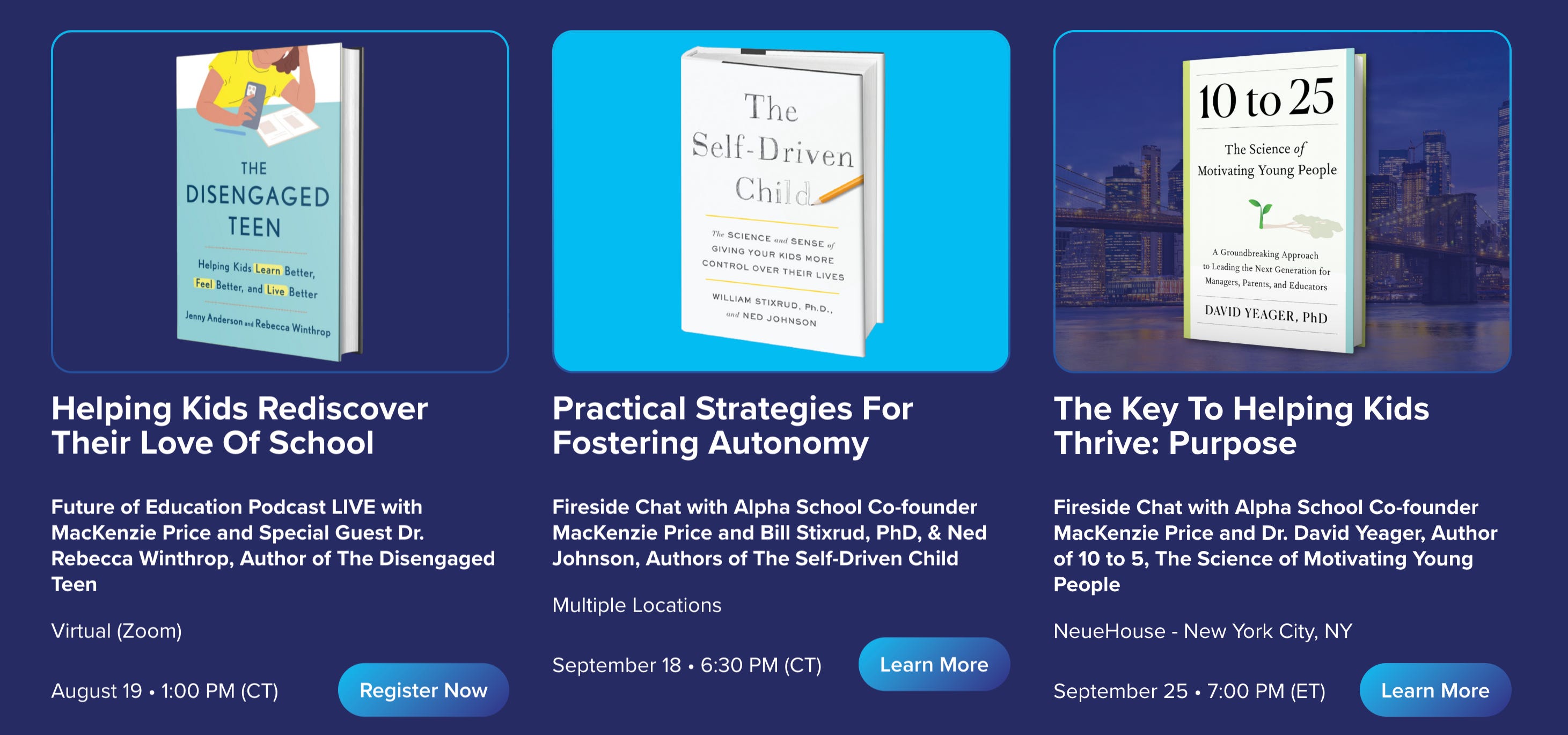
I’m hosting some live events this fall. They’re totally free to tune in and listen. You can register for my upcoming talk with Dr. Rebecca Winthrop on August 19th at 1 pm CT. I’d love to see you there!
This resonates deeply. That human connection is what drew me to teaching in the first place and it’s what I still want to spend more of my time doing.
Too often, that gets crowded out by my endless preparation and corrections, leaving less space for the real heart of the work. The idea that AI can free us to connect more, while also personalizing learning so every student, from those who need the most help to those bored in class to be is challenged in the right way, is incredibly exciting.
It feels like a real path to the kind of teaching I envisioned when I first started.
Thank you for showing the real possibilities!
Godspeed to this project-- as an international school IB teacher, middle level leader and digital learning admin over the past 20 years-- Education with a capital E is desperately in need of competition, change...the list of needs is long. Hell, just my tiny, common sense project to bring a lean/agile collaboration model so IT/Edtech coaches/teachers can proactively plan and integrate technology faces an incredible uphill battle against the sclerotic, siloed beast.
Whether your model or another gains significant traction time will tell-- many appreciate what you're doing. The kids and people are well worth it so thank you for making this case.