


It’s true. Kids can crush academics in just two hours a day. It’s happening right now in the halls of our flagship school, Alpha School.
It works like this:
Mornings are for academics. Kids spend two hours immersed in deep, focused learning with traditional academia: math, reading, science, history.
Afternoons are for life skills. Kids spend four hours participating in workshops building real-world skills: public-speaking, entrepreneurship, creative writing, financial literacy, and more.
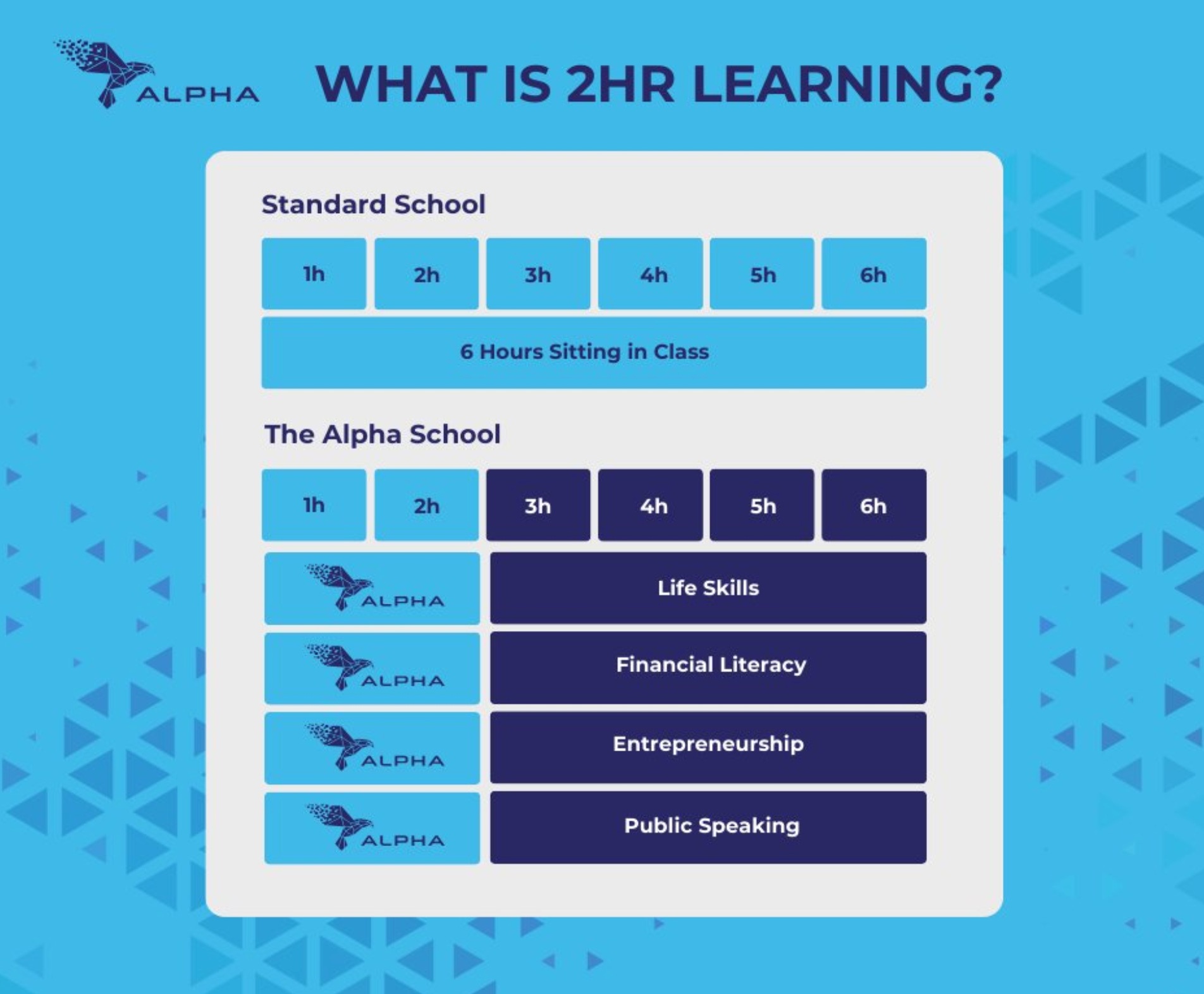
Kids aren’t built to sit butt-in-chair for six hours a day. Intuitively, we know this. They need movement and conversation, things to build and challenges to overcome. It’s frustrating enough for adults to be tethered to their desk all day. Why subject kids to the same fate? Why not fill their afternoons with activities that inspire them, that show them how the world actually works? Say, launching a food truck business, or writing a Broadway musical, rather than nodding off during post-lunch afternoon algebra. Kids are far more capable than we give them credit for, and the two-hour school day can unleash their potential by giving them their time back.
Just two hours a day can lead to remarkable outcomes
At Alpha, our classes rank in the top 1% nationally across nearly every subject. We have students complete more than two grade levels in just six months. In traditional schools, a fifth grader who gains four points in math gains eight at Alpha. For a seventh grader in the 99th percentile at a traditional school, that jump is from seven points to 14.
We’ve seen firsthand how kids from all different kinds of backgrounds can thrive within this model. One of our campuses lies in the heart of one of the poorest districts in America, and many of our students there come from significantly disadvantaged backgrounds. Even still, they learn at more than twice the rate of their peers in traditional schools. Socioeconomic status does not sway the success of the model.
And the data doesn’t stop there. On average, our high schoolers score a 1470 on their SAT. Our alumni get accepted to elite institutions like Stanford, NYU Shanghai, and Howard University, all while spending just two hours a day on academics.
And younger students? To be honest, we doubted this model could even work for kids as young as kindergarten. We were wrong. Nearly all of our kindergarten classes rank in the top 1% for both knowledge and learning speed after just one year.
There was a time I had no idea this level of success was even possible as a parent. Maybe you feel the same. Maybe you assume this scale of success is reserved for the little Einsteins, the once-in-a-generation geniuses, the kids who slide straight out of the womb reciting the digits of Pi. But that’s no longer true. Alpha students are “average” kids (if we can call any kid “average”) who are put in the right environment with the right amount of support to thrive.
So, what makes the Alpha model tick? Why does it work so well?
The secret is, and always will be, personalized education
The genius of the two-hour model can be summed up into seven syllables: individualization.
We’re used to education molding kids into little standardized clay pots, and this works fine for the few but leaves most kids floundering. The two-hour model follows a different philosophy, one that prioritizes the personal needs of each kid. There are two keys to success here: individualized AI tutoring and mastery-based learning.
Individualized AI tutoring supercharges kids’ learning
If you’re flinching at the idea of “an AI tutor,” just know: this isn’t some Silicon Valley fever dream where we hand kids a tablet and say, “Let us know when you’ve finished high school.” Nor is it a dystopian fantasy where kids only want to hang out with their chatbot.
In the right environment, with the right supervision, AI supercharges kids’ learning.
A few years ago, an eighth grade girl enrolled in Alpha. We realized she was academically behind; three years behind, to be exact. She had only mastered up to fifth-grade concepts. Within one year of working with an AI tutor, she was ready for high school. Knowledge gaps across four years of schooling were closed in just 365 days. Such is the power of personalized AI tutoring.
What if every kid in the classroom could have their own unique lesson plan like this? Every facet of the curriculum tailored to their struggles, their interests, their own little starburst of genius.

“YOU get a personalized education! And YOU get a personalized education!”
Struggling with math? An AI tutor not only blocks out extra time for students to practice equations, but it personalizes learning to the student so these numbers click, to make math feel relevant and not so “mathy.”
Excellent writer? An AI tutor challenges students with more advanced curriculum, pushing them higher and higher, sharpening their genius in ways that conventional education is simply unable to do.
The rise of AI tutors will only continue to revolutionize education, not because it’s easy and efficient (it is), but because it’s extraordinarily effective.
Mastery-based learning is a necessity
Let’s role play for a moment. You’re a CEO, and you have one employee who only understands about 70% of their role. Do you give them a promotion? No, of course not. You expect them to show competency in their field before you give them more responsibility. And yet, we allow students who understand just 70% of the curriculum to progress to the next grade.
Have you ever paused to wonder how unjust this is for kids? Over time, the gaps in their knowledge will compound. They will develop intense blindspots. And inevitably, they will fall behind.
Within the two-hour learning model, mastery is non-negotiable. Instead of slopping through six hours of monotonous busy work, Alpha students learn in quick, intense bursts of productivity. They’re required to demonstrate clear fluency in a topic before advancing onto the next.
Mastery-based learning isn’t a luxury. It’s a necessity.
A quick disclaimer…
There are no magic bullets in education, and two-hour learning is no exception. This model won’t work for everyone. That’s the point. One-size-fits-all education is the very war that we’re waging.
A two-hour school day won’t be effective for every kid, but it can be highly effective for 80–90% of kids. Not because it offers some elite, exclusive curriculum, but because it offers personalized learning. This is a glimpse into what education can and should be: invigorating, joyful, tailored to the individual, designed to maximize the potential of the next generation.
Welcome to the future of education. You're just in time.
I love everything about this approach. I truly wish I had this as a child. I have two little ones - four and 10 months. I am terrified to send them into a traditional school structure. I am also trying to balance cost and flexibility. I saw the costs of your schools in Texas and it seemed way out of the price range for most. The latest google search says - between $25,000 and $40,000 per year. Are you planning to roll out a 2 hr curriculum for people to adopt for homeschool or other types of schooling that are public/affordable models?
I run a K-12 private school with around 125 students, and I've been intrigued by this model of education for our students. Do you have any resources that you would recommend that I should look into as I continue to research?