


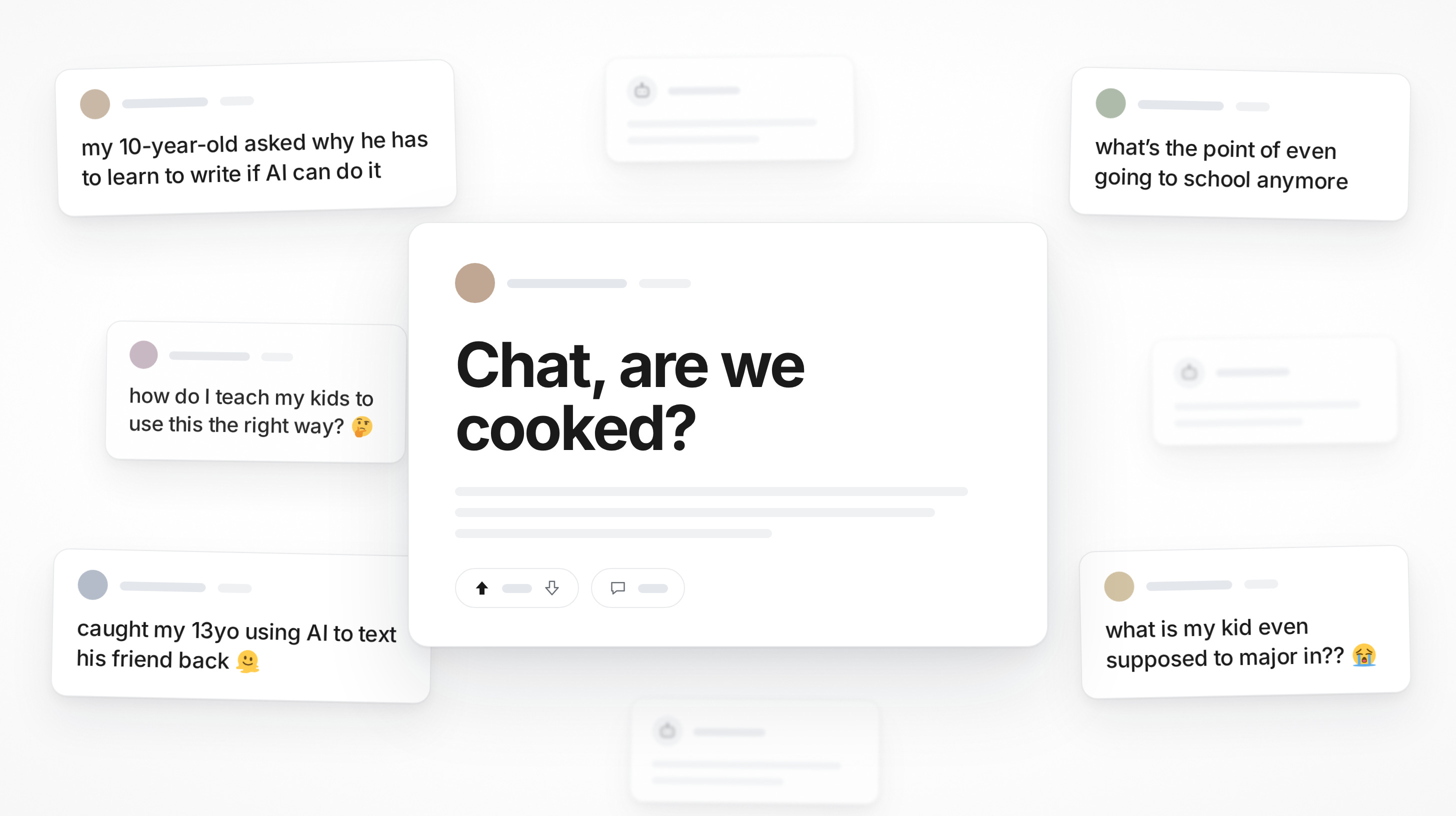
I recently stumbled upon a Reddit thread titled, “Chat, are we cooked?” where the writer anxiously worried if AI in schools will ruin our children’s brains. It’s a valid worry. More teachers than ever are voicing concerns over what’s happening inside the system, from 17-year-olds who can’t read, to 14-year-olds who melt down when something takes longer than a TikTok, to 12-year-olds who don’t allow themselves a millisecond of original thought before reaching for ChatGPT.
Underneath all of this is one big, scary question parents are asking everywhere: if AI can do everything, what is left for my kid?
As the founder of a school where every student uses AI to master their academics and free up the rest of their afternoon, I have a lot of thoughts on this. The worst thing we can do is sit back and let AI simply happen to our kids. We cannot let technology waltz in and dictate who our children become and what they accomplish. We are the humans. AI is the tool. We have to raise our kids to be the authors of their own lives, teaching them how to use technology to their advantage instead of being used by that technology.
But doing so requires way more intentionality and elbow grease than it has in the past. The strange twist is that AI itself is one of the most helpful ways to do it. We can use AI to raise kids who beat AI.
For generations, school has trained kids to do exactly what AI now does best, like following instructions and regurgitating information. These will always be important for kids to learn, but we can’t stop there. We need to actively help our kids flourish in their unique humanity, developing their creativity, communication, collaboration, and critical thinking. And when used the right way, I believe AI can be the most hopeful and moral thing to happen to education in a century.
A tutor for every student (finally)
Imagine your kid is sitting across the table from a human tutor. Maybe they’re sitting at an old-fashioned mahogany desk in a moody library, or in a sleek modern classroom, or at your own kitchen table. This tutor has one job, and that job is to help your kid master academics. There are no distractions, no other students who require their attention. They are invested solely in what your kid needs to learn.
You can imagine how much faster and more efficiently your kid would be able to learn. This is why one-on-one tutoring is considered the caviar of learning.
In 1984, educational researcher Benjamin Bloom found that students who learned with a personal tutor scored two standard deviations higher than students in a regular classroom. This means that the students who received personalized learning outperformed 98% of the students who learned the same material in a standardized lecture. Bloom called it the 2 Sigma Problem. Why a problem? Because there was no way to scale it.
Until now.
With AI tutors (also known as adaptive apps), kids can now receive a personalized, one-to-one learning experience, at scale, from anywhere in the world. In a recent Harvard study, students who learned physics with an AI tutor learned more than twice as much, in less time, as students in an active-learning classroom. Bloom would be ecstatic.
Of course, it’s much harder to picture your kid working with an AI tutor at the kitchen table than with a human tutor. So what does this actually look like?
We use AI tutors at Alpha School, so I’ll give you a visual to show you how it works.
Two hours of academics, then the laptops close
For the first two hours of the school day, laptops are open. Students log into their AI-powered dashboard (ours is called TimeBack) and dive into their academics for the day. Every student learns the same curriculum, like Common Core, but at their own pace, on their own time. The AI keeps track of when a student is struggling and when they’re breezing ahead, then feeds them the exact right material they need for their knowledge level, just like a human tutor would. Meanwhile, we shift the human role from “teachers” to “guides,” who act as motivational coaches for students rather than academic lecturers.
After two hours, the laptops close. Kids break for lunch, then spend the rest of the afternoon participating in workshops where they do hands-on group projects and build life skills together.
Because every student at Alpha receives a personalized learning plan, our students are able to master their academics in two hours rather than six. But the goal isn’t to burn through academics as fast as possible. Learning isn’t some video game to be beaten. The real value of AI tutors, and what I believe to be the future of education, is that kids can get more time back in their day. It is here, in this newfound free time, where kids can develop those deeply human skills that are going to allow them to flourish and become irreplaceable: creativity, communication, collaboration, and critical thinking.
This is what I mean when I say we can use AI to raise kids who beat AI.
By leveraging AI in the right ways, we can help kids master academics in a fraction of the time, then spend the time they get back sharpening all of those skills that make them uniquely human.
For example, our kindergartners train to run 5Ks, climb 40-foot rock walls, plan their own playdates, and cook their own meals. At this age, kids learn that confidence comes from competence. By middle school, Alpha students give TEDx Talks and launch their first businesses. This is the age when kids learn how to start making an impact in the real world. In high school, every Alpha student spends four years on a passion project of their choosing, building it to an Olympic level. (One student wrote, produced, and staged an all-teens musical that received 30 million views on TikTok and a sold-out debut at a Tony Award-winning venue. Another student produced a documentary about cancer, food, and lifestyle that received over 5.3 million views and led to her testifying in front of Congress.) At this age, kids can become builders and creators who are experts in their field.
So, what does all this mean for you?
Raising kids who use technology, not the other way around
If you aren’t already, it’s time to become an active participant in your kid’s education. We can no longer afford to sit back and assume that school is teaching kids everything they need to know, including how to use AI the right way. You need to get involved, ask questions, be a major resource, and help your kids figure it out. Your children look up to you. You can set the tone of their relationship with technology and education.
Start experimenting with adaptive apps. You don’t have to come to Alpha School to do this. There are plenty of great apps you can download. I’ve shared nine of them here. If your seventh grader is struggling with fractions, an adaptive app can find the holes (maybe they go all the way back to fourth grade) and fill them one topic at a time until she reaches mastery. And if your kid doesn’t want to come home from school and do more school, try building a simple reward system or motivational model at home.
Start actively teaching your kid life skills. “Soft skills” are no longer a nice-to-have. They’re an essential part of raising kids who are competent and capable in a rapidly evolving and volatile world. Parents, lovingly, this means you need to stop doing everything for your kids. Stop solving all their problems. Start giving them real responsibility.
It’s up to us
“So chat, are we cooked?”
Well, that’s up to us.
If you’ve seen The Dark Knight, you know Harvey Dent, the villain who makes decisions with a coin flip and leaves everything up to chance. We cannot raise our kids that way. Bloom’s 2 Sigma Problem has sat dormant for 42 years, waiting for technology to catch up. It finally has. Let’s raise kids who are the authors of their own lives.
Let’s not leave their futures up to chance.